
Sat - Thu 9.00 AM - 6.00 PM
PVC Type DB-100 Conduit – 40 mm (1¼″) | Direct Burial
Saudi Ducts > PVC Type DB-100 Conduit – 40 mm (1¼″) | Direct Burial
PVC Type DB‑100 Conduit – 40 mm (1¼″)
Heavy-Duty Direct Burial Electrical Conduit for Power, Telecom & Utility Projects in KSA & Gulf Region
The Kingdom of Saudi Arabia and the Gulf region are investing heavily in modern infrastructure projects, which include things like power distribution, telecommunication networks, smart city initiatives, and municipal utility infrastructures; all of which are dependent on durable and high-performance underground conduits. The selection of the most appropriate conduit is a critical factor for the protection of cables in the long run, the safety, and the maintenance efficiency, among other things.
The PVC Type DB‑100 Conduit – 40 mm (1¼″) | Direct Burial not only satisfies but also excels in meeting the standards for heavy-duty protection, the resistance to environmental factors, and mechanical strength. The conduit’s diameter of 40 mm allows for the installation of more cables, which in turn allows for the routing of several power and communication lines through just one conduit.
The PVC Type DB‑100 Conduit – 40 mm (1¼″) is a heavy-wall, rigid PVC conduit designed for direct burial installations, offering superior protection for electrical, communication, and control cables in underground projects. Engineered for high mechanical strength and long-term durability, the DB‑100 40 mm conduit is ideal for residential, commercial, municipal, and light industrial applications across the Gulf region, including Saudi Arabia, UAE, Qatar, Oman, Bahrain, and Kuwait.
Manufactured from high-quality rigid PVC, it provides corrosion resistance, chemical stability, and electrical safety in harsh environments. Its thick DB‑100 wall ensures protection against soil pressure, minor impacts, and environmental stress, while the smooth interior facilitates easy cable pulling. The conduit’s heavy-duty design makes it suitable for direct burial without concrete encasement, saving costs and simplifying installation.
With a service life of 30–50 years, the PVC DB‑100 40 mm conduit is a reliable, cost-effective, and future-proof solution for critical underground cable installations in the Gulf’s challenging soil and climate conditions.
The Kingdom of Saudi Arabia and the Gulf region are investing heavily in modern infrastructure projects, which include things like power distribution, telecommunication networks, smart city initiatives, and municipal utility infrastructures; all of which are dependent on durable and high-performance underground conduits. The selection of the most appropriate conduit is a critical factor for the protection of cables in the long run, the safety, and the maintenance efficiency, among other things.
The PVC Type DB‑100 Conduit – 40 mm (1¼″) | Direct Burial not only satisfies but also excels in meeting the standards for heavy-duty protection, the resistance to environmental factors, and mechanical strength. The conduit’s diameter of 40 mm allows for the installation of more cables, which in turn allows for the routing of several power and communication lines through just one conduit.
The PVC Type DB‑100 Conduit – 40 mm (1¼″) is a heavy-wall, rigid PVC conduit designed for direct burial installations, offering superior protection for electrical, communication, and control cables in underground projects. Engineered for high mechanical strength and long-term durability, the DB‑100 40 mm conduit is ideal for residential, commercial, municipal, and light industrial applications across the Gulf region, including Saudi Arabia, UAE, Qatar, Oman, Bahrain, and Kuwait.
Manufactured from high-quality rigid PVC, it provides corrosion resistance, chemical stability, and electrical safety in harsh environments. Its thick DB‑100 wall ensures protection against soil pressure, minor impacts, and environmental stress, while the smooth interior facilitates easy cable pulling. The conduit’s heavy-duty design makes it suitable for direct burial without concrete encasement, saving costs and simplifying installation.
With a service life of 30–50 years, the PVC DB‑100 40 mm conduit is a reliable, cost-effective, and future-proof solution for critical underground cable installations in the Gulf’s challenging soil and climate conditions.
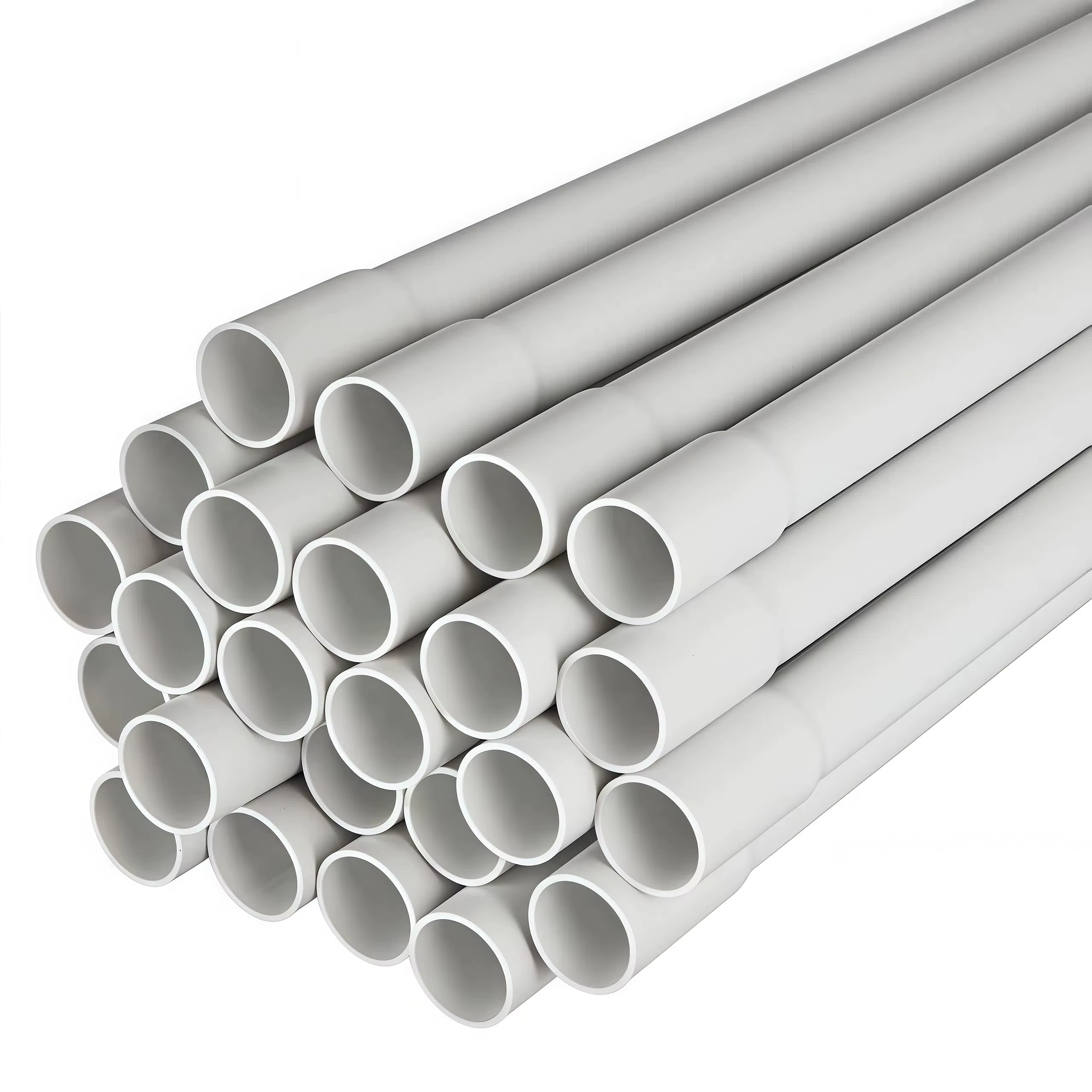
What Is PVC Type DB‑100 Conduit – 40 mm?
The PVC Type DB‑100 Conduit – 40 mm (1¼″) is a heavy wall direct burial conduit the main purpose of which is to protect underground electrical, telecom, and control cables. The high mechanical strength guaranteed by its DB‑100 classification makes it a product that can resist soil pressure, minor impacts, and even environmental stress without the use of a concrete encasement.
The 40 mm diameter permits the use of larger cable bundles which makes it ideal for residential, commercial, and utility infrastructure projects where multiple runs or thicker conductors are required.
Understanding DB‑100 Direct Burial Classification
“DB” stands for Direct Burial, and “100” indicates a heavy-wall PVC conduit capable of withstanding high soil pressure and minor mechanical impact.
Key Attributes
Thick walls for enhanced mechanical protection
Designed for direct burial in trenches
Resistant to soil pressure, moisture, and minor excavation forces
Ideal for critical underground installations
DB‑100 conduits are widely used for GCC infrastructure projects where durability and reliability are paramount
Why PVC Conduits Are Preferred in Gulf Region Infrastructure
In Saudi Arabia and the Gulf, PVC conduits are the first choice because of the following:
Corrosion and Chemical Resistance.
PVC is the material that does not corrode or get ruined by saline, alkaline, or moisture-rich soil.
Heat Resistance.
High ambient and soil temperatures are not a threat to the structural integrity of PVC.
Electrical Safety.
The non-conductive property of PVC ensures no electrical hazards.
Lightweight and Simple Installation.
All the above reasons lead to easy transportation and installation which reduces the cost of labor.
Long Service Life.
30-50 years of trouble-free operation can be expected even in difficult underground environments.
Material Standards & Compliance
The DB‑100 40 mm conduit meets all major international and regional standards:
ASTM D1785 / D2241 – Rigid PVC pipe/conduit
NEMA TC-6 & TC-8 – Electrical conduit performance
IEC 61386 – International conduit systems standard
UL 651 / ETL (optional) – Electrical safety compliance
Compliance guarantees mechanical strength, thermal stability, and electrical safety in Gulf region installations.
Technical Specifications – DB‑100 40 mm Conduit
| Specification | Details |
|---|---|
| Nominal Diameter | 40 mm (1¼″) |
| Material | Rigid PVC |
| Wall Class | DB‑100 (Heavy Wall) |
| Installation Type | Direct burial |
| Standard Lengths | 2 m, 3 m, 6 m |
| Joint Type | Solvent weld / Mechanical coupler |
| Operating Temperature | −10°C to +60°C |
| Color | Grey |
| Applicable Standards | ASTM, NEMA, IEC, UL/ETL |
| Service Life | 30–50+ years |
Key Features & Performance Benefits
- Heavy-wall construction guarantees the utmost protection from mechanical damage
- 40 mm diameter offers the possibility of running several cables at the same time
- Interior surface is smooth and hence makes cable installation easy
- The surface is resistant to corrosion and chemicals
- Electrical safety is guaranteed because of its non-conductive property
- It can be buried directly without the need for concrete
- No more frequent replacement required as it has a long service life, thus making it an economical underground infrastructure
Typical Applications
Residential: Underground power distribution
Commercial: Office buildings, shopping centers, parking areas
Municipal: Street lighting, public utilities, smart city cabling
Telecom: Fiber optic and communication lines
Light Industrial: Control and instrumentation wiring
How DB‑100 Direct Burial Systems Work
The pipeline is dug into trenches, connected through solvent weld or mechanical couplings, and covered with soil again. It ensures a safe route for the underground wires and makes changes or repairs possible without causing any harm in the future.
Step-by-Step Installation Guide
- Excavate trench to design depth
- Prepare soil base that is smooth; sand bedding is optional
- Trench DB-100 40 mm conduit laying
- Section joints are secure by means of couplers
- Conduit carries the cables through
- Trench is backfilled and compacted
- Warning tape above the conduit is installed
Design Considerations for KSA & Gulf Region
Extreme ambient and soil temperatures
Sandy and saline soil conditions
Light surface load areas
Provision for future expansion
Compliance with local utility regulations
Accessories & Fittings
Solvent weld couplers
Mechanical couplers for repairs
45° and 90° elbows
Pulling eyelets
Spacer clips and warning tapes
Performance in Harsh Environmental Conditions
- UV-resistant for storage and handling
- Resistant to moisture and chemicals
- Preserves stiffness during soil settlement and vibration
- Durable over a long time in desert, coastal, and urban locations
Maintenance & Inspection
Minimal maintenance required
Inspect during trench excavation or upgrades
PVC does not corrode or rust, reducing lifecycle costs
Cost Efficiency & Lifecycle Advantages
-Huge savings on installation costs (no need to cast it into concrete)
- Project concluded fast
- Less damage to cable
- Long service life assures a high return on investment
Conclusion
The PVC Type DB‑100 Conduit – 40 mm (1¼″) | Direct Burial is an extremely reliable, heavy-duty, and cost-effective underground cable protection solution for projects in the Saudi Arabia and Gulf region. Its heavy-wall construction, resistance to corrosion, larger diameter, and long service life have made it suitable for use in residential, commercial, municipal, and light industrial areas.
The selection of DB‑100 40 mm conduit comes with the advantage of safe, efficient, and future-ready underground cabling, requiring minimal maintenance and providing maximum long-term reliability even in the harshest Gulf environments.
Frequently Asked Questions (FAQs) – PVC Type DB‑100 Conduit – 40 mm (1¼″) | Direct Burial
1. What is PVC Type DB‑100 Conduit – 40 mm (1¼″) used for?
It is used for direct burial protection of electrical, telecom, and control cables in underground installations, providing mechanical and environmental protection without concrete encasement.
2. Can DB‑100 conduit be buried directly without concrete?
Yes, it is specifically designed for direct burial applications, eliminating the need for concrete encasement while maintaining high durability.
3. What is the difference between DB‑100 and DB‑60 conduits?
DB‑100 has heavier wall thickness and higher mechanical strength, suitable for more demanding underground installations, whereas DB‑60 is a medium-wall conduit for lighter load applications.
4. Is PVC DB‑100 40 mm suitable for Gulf region climates?
Absolutely. It performs reliably in high temperatures, sandy soils, and saline conditions typical of Saudi Arabia, UAE, Qatar, Oman, and Bahrain.
5. Can DB‑100 conduit be used for fiber optic cables?
Yes, the smooth inner surface ensures easy cable pulling and prevents damage to fiber optic and communication cables.
6. What lengths are available for DB‑100 40 mm conduit?
Standard lengths include 2 meters, 3 meters, and 6 meters, with couplers used to join longer runs.
7. Is PVC DB‑100 conduit electrically safe?
Yes, PVC is non-conductive, making it safe for underground electrical installations.
8. What type of joints and fittings are used with DB‑100 40 mm conduit?
The conduit uses solvent weld couplers or mechanical couplers, along with 90°/45° bends, pulling eyelets, and warning tapes for a complete direct burial system.
9. How long is the expected service life of DB‑100 40 mm conduit?
Typically, 30–50 years, depending on soil conditions and installation quality.
10. Is DB‑100 conduit compliant with regional and international standards?
Yes, it meets ASTM, NEMA, IEC, and optional UL/ETL standards, ensuring quality, safety, and durability for Gulf region projects.
Premium 40mm PVC DB100 Conduit – Trusted Suppliers & Fast Delivery
The 40mm PVC DB100 Conduit is a robust direct burial solution ideal for underground electrical and telecom networks. Engineered from high-quality PVC, it provides excellent mechanical strength, chemical resistance, and long-term durability, protecting fiber optic cables, power lines, and telecom infrastructure even in challenging conditions.
Through Saudi Ducts, buyers can directly connect with certified manufacturers, approved distributors, and premium suppliers across Saudi Arabia and the GCC, ensuring quick delivery and reliable sourcing for FTTx, smart city, and electrical infrastructure projects.
Key Benefits:
Premium PVC material ensures durability and corrosion resistance
40mm diameter suitable for medium-scale fiber and electrical installations
DB100 rated for direct burial applications
Compatible with fiber optic cables and electrical wiring
Fast, verified delivery from suppliers in the GCC
PVC DB100 Conduit Technical Insights & Best Practices
PVC DB100 vs HDPE Direct Burial Conduits
| Feature | PVC DB100 Conduit | HDPE Conduit |
|---|---|---|
| Material Strength | High | Very High |
| Flexibility | Moderate | High |
| UV & Chemical Resistance | Excellent | Excellent |
| Installation | Direct Burial / Pulling | Pulling or Blowing |
| Typical Use | Underground electrical & fiber | Fiber optic FTTx networks |
Installation & Best Practices:
Maintain proper trench depth and bedding standards for long-term protection
Ensure smooth bends and radius compliance for easy cable pulling
Install end caps to prevent debris and water entry
Use sand or granular bedding for cushioning the conduit
Color-code conduits to differentiate fiber vs electrical applications
Following these practices ensures efficient cable deployment, minimal maintenance, and longer network lifespan.