
Sat - Thu 9.00 AM - 6.00 PM
PVC Type DB-120 Conduit – 225 mm (9″) | Heavy Duty Direct Burial
Saudi Ducts > PVC Type DB-120 Conduit – 225 mm (9″) | Heavy Duty Direct Burial
PVC Type DB‑120 Conduit – 225 mm (9″) | Heavy-Duty Direct Burial
Heavy-Duty Direct Burial Electrical Conduit for Power, Telecom & Utility Projects in KSA & Gulf Region
The PVC Type DB‑120 Conduit – 225 mm (9″) is a hard-wearing and unbending PVC conduit made for underground installation and giving mechanical protection, resistance to rust, and long-lasting performance. The diameter of 225 mm makes it possible to install cables of large volume, hence the areas of application are power distribution, telecom networks, and industrial cabling, and the like.
Suffixed by the DB‑120, the classification gives the conduit the best wall thickness and strength so that it can endure soil pressure, environmental stress, and surface loads without needing concrete encasement.
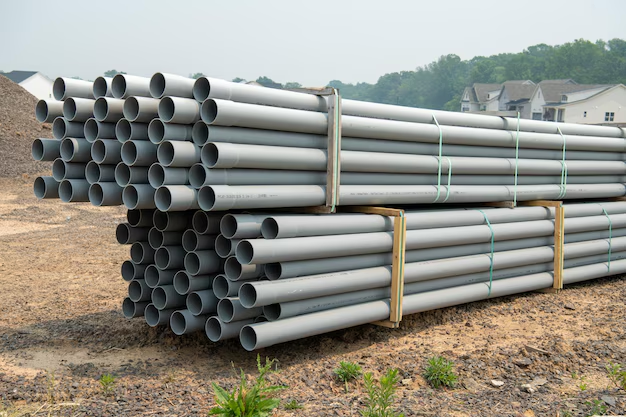
The PVC Type DB‑120 Conduit – 225 mm (9″) is a heavy-duty, large-diameter rigid PVC conduit engineered for direct burial underground cable protection. Its DB‑120 classification ensures maximum mechanical strength, durability, and corrosion resistance, making it ideal for underground electrical, telecom, fiber optic, and industrial cabling in Saudi Arabia, UAE, Qatar, Oman, Bahrain, and Kuwait.
The 225 mm internal diameter supports high-capacity cable installations and allows for future expansion of utility networks. Made from premium-grade rigid PVC, the conduit is non-conductive, lightweight, and easy to install, while resisting soil pressure, moisture, chemical corrosion, and environmental stress.
The PVC Type DB‑120 Conduit – 225 mm (9″) is a hard-wearing and unbending PVC conduit made for underground installation and giving mechanical protection, resistance to rust, and long-lasting performance. The diameter of 225 mm makes it possible to install cables of large volume, hence the areas of application are power distribution, telecom networks, and industrial cabling, and the like.
Suffixed by the DB‑120, the classification gives the conduit the best wall thickness and strength so that it can endure soil pressure, environmental stress, and surface loads without needing concrete encasement.
The PVC Type DB‑120 Conduit – 225 mm (9″) is a heavy-duty, large-diameter rigid PVC conduit engineered for direct burial underground cable protection. Its DB‑120 classification ensures maximum mechanical strength, durability, and corrosion resistance, making it ideal for underground electrical, telecom, fiber optic, and industrial cabling in Saudi Arabia, UAE, Qatar, Oman, Bahrain, and Kuwait.
The 225 mm internal diameter supports high-capacity cable installations and allows for future expansion of utility networks. Made from premium-grade rigid PVC, the conduit is non-conductive, lightweight, and easy to install, while resisting soil pressure, moisture, chemical corrosion, and environmental stress.
Understanding DB‑120 Heavy Duty Classification
Depending on the thickness of the wall and the mechanical strength, PVC conduits are separated into different categories. The DB‑120 conduits are among the heavyduty types. They have the following features:
- Heavy soil load capacity
- Protection from minor mechanical impacts
- Underground installation with no concrete
- Large cables installation
This characteristic of the DB‑120 conduits makes them very suitable for reaching up to the capacity of utilities and infrastructure projects even under the toughest conditions of the Gulf.
Why PVC Is the Preferred Material for Gulf Region Installations
PVC offers several advantages:
Corrosion & Chemical Resistance – Resists saline and alkaline soils
Thermal Stability – Retains strength under high Gulf temperatures
Non-Conductive – Improves underground electrical safety
Lightweight & Easy Handling – Reduces installation cost and labor
Long Service Life – 30–50+ years with minimal maintenance
Material Standards and Compliance
ASTM D1785 / D2241 – Rigid PVC conduit
NEMA TC‑6 / TC‑8 – Conduit strength standards
IEC 61386 – International conduit standard
UL 651 / ETL (optional) – Electrical safety certification
Ensures consistent quality, durability, and safety in Gulf infrastructure projects.
Technical Specifications —DB‑120 225 mm Conduit
| Specification | Details |
|---|---|
| Nominal Diameter | 225 mm (9″) |
| Material | High-grade rigid PVC |
| Conduit Type | DB‑120 Heavy Duty, Direct Burial |
| Installation | Direct burial without concrete |
| Standard Lengths | 2 m, 3 m, 6 m |
| Joint Type | Solvent weld / Mechanical coupler |
| Operating Temperature | −10 °C to +60 °C |
| Color | Grey (standard) |
| Standards | ASTM, NEMA, IEC, UL/ETL (optional) |
| Expected Service Life | 30–50+ years |
Key Features & Performance Advantages
- Heavy-Wall DB‑120 Construction – Maximum protection against soil loads
- Large 225 mm Diameter – Supports high-capacity cables
- Smooth Interior – Easy cable pulling
- Corrosion & Chemical Resistant – Ideal for Gulf soils
- Non-Conductive – Enhances electrical safety
- Direct Burial Ready – No concrete needed
- Long Lifecycle – 30–50+ years
Typical Applications
- Residential & Commercial – Power distribution, telecom and utility corridors
- Industrial Projects – Plants, refineries and factories
- Municipal Utilities & Smart Cities – Street lighting, traffic signals and fiber networks
- Telecom & Data Networks – High-capacity fiber and communication lines
How DB‑120 Direct Burial Systems Work
- Trenches with the right alignment and bedding were laid.
- Soldered or mechanical couplers were employed for the joining process.
- The whole package consists of elbow fittings, pulling eyelets, and warning tapes.
- The soil pressure, moisture, and even minor mechanical impacts are kept away from the cables.
Installation Method – Step by Step
Site Assessment & Trench Design – Plan route, depth, and alignment
Excavation – Dig trench, remove rocks and debris
Bedding Preparation – Smooth sand or soil base
Laying Conduit Sections – Ensure proper alignment
Jointing – Solvent weld or mechanical couplers
Cable Pulling – Carefully pull cables using lubricants if needed
Backfilling – Layered backfill with light compaction
Installing Warning Tape – Alerts future excavators
Design Considerations for KSA & Gulf Region
- Type of soil, temperature, and salt content
- The current capacity of cable and possible expansion in the future
- Adherence to local rules and regulations
- Accessibility for maintenance in the future upgrades
Accessories & Fittings
Solvent Weld / Mechanical Couplers
45° & 90° Elbows
Pulling Eyelets
Marker Tape & Warning Mesh
Spacer Clips & Support Saddles
Performance in Harsh Soil & Climate Conditions
- Desert sands and high temperatures
- Coastal saline soils
- Surface loads, and minor impact
Maintenance & Inspection
Inspect joints and warning tapes during upgrades
Minimal maintenance due to PVC’s durability
Update as-built documentation
Cost Efficiency & Lifecycle Benefits
- No solid casement cuts expenses
- Lightweight, installation without complications, and thus labor-saving
- Very long lifespan (30 to more than 50 years)
- Enables upcoming cable expansion
Conclusion
The Heavy Duty Direct Burial PVC Type DB-120 Conduit – 225 mm (9″) is an ultimate solution for underground cable laying in KSA and the Gulf region projects. It provides great protection, keeps the cable safe from corrosion, and has a long life. Its heavy-duty wall, large diameter, and direct burial plan make it suitable for utility networks of all types such as residential, commercial, industrial, and municipal.
By choosing the 225 mm PVC DB-120 conduit, engineers and contractors will not just have an infrastructure that is cost-effective but also dependable and future-proof. The networks of power, telecom, and fiber will be hidden under the ground and protected from the harsh Gulf environments for decades.
Frequently Asked Questions
1. What is PVC DB‑120 225 mm conduit used for?
It is designed for high-capacity underground cable protection, including electrical, telecom, and fiber optic cables, in direct burial installations across residential, commercial, industrial, and municipal projects.
2. Can DB‑120 225 mm conduit be buried directly without concrete?
Yes. The heavy-duty DB‑120 classification allows for direct burial without concrete encasement while maintaining mechanical strength and environmental protection.
3. What is the difference between DB‑120 and DB‑100 conduits?
DB‑120 conduits have thicker walls and higher mechanical strength, suitable for heavier soil loads and large-diameter cables, whereas DB‑100 is lighter and designed for moderately demanding installations.
4. Is PVC DB‑120 225 mm suitable for Gulf region climates?
Absolutely. It withstands high temperatures, sandy soils, saline conditions, and humidity, making it ideal for Saudi Arabia, UAE, Qatar, Oman, Bahrain, and Kuwait.
5. Can fiber optic and communication cables be installed in DB‑120 conduits?
Yes. The smooth internal surface ensures easy cable pulling and prevents damage to fiber optic and telecom cables, supporting multiple cables in one conduit.
6. What lengths are available for DB‑120 225 mm conduit?
Standard lengths include 2 m, 3 m, and 6 m, which can be joined using solvent weld or mechanical couplers for longer runs.
7. Is PVC DB‑120 225 mm conduit electrically safe?
Yes. PVC is non-conductive, ensuring electrical safety for underground installations.
8. What fittings and accessories are compatible with DB‑120 conduits?
Compatible accessories include solvent weld couplers, mechanical couplers, 45° & 90° elbows, pulling eyelets, spacer clips, and warning tapes, ensuring a complete and durable system.
9. What is the expected service life of DB‑120 225 mm conduit?
Typically, 30–50+ years, depending on soil conditions and installation quality, offering long-term reliability with minimal maintenance.
10. Does DB‑120 conduit comply with international and regional standards?
Yes. It meets ASTM, NEMA, IEC, and optional UL/ETL certifications, ensuring quality, safety, and performance in Gulf region infrastructure projects.
Premium 225mm PVC DB120 Conduit Heavy Duty – Suppliers, Manufacturers & Delivery
The 225 mm PVC DB120 conduit is a very strong and durable pipe for underground usage where heavy loads need to be carried over large distances. This pipe has been designed specifically to withstand an enormous amount of weight while being resistant to corrosion and will last for decades. The 225mm DB120 Conduit works exceptionally well in large construction sites and on the highway; and also with FTTx deployments and utility infrastructure throughout the Middle East, including Saudi Arabia.
By using Saudi Ducts, EPC contractors, telecom service providers and infrastructure developers can connect to a network of certified manufacturers, approved/supported suppliers and registered distributors that provide a high-quality 225mm PVC DB120 Heavy Duty conduits, including project ready delivery, as well as technical assistance on how to install for direct burial.
Capabilities of Suppliers Include:
- Production of EXTRA HEAVY DUTY 225mm PVC DB120 Conduits to accommodate large load demands for Industrial, Highway/Telecom Networks
- Supplied on site at FTTX, Utility and Infrastructure project sites with heavy load demands
- Complying with ISO, ASTM, and GCC Infrastructure Quality Standards
- Providing bulk delivery and logistics throughout Saudi Arabia and the GCC region.
- Providing expert installation, trench preparation, and future cable expansion assistance.
Saudi Ducts enables buyers to find verified suppliers, evaluate product specifications and initiate direct purchasing conversations with either the manufacturer of the products or with a distributor.
225mm PVC DB120 Conduit – Industry Insights & Best Practices
PVC DB120 conduits are engineered for very high-load underground applications, suitable for industrial, highway, and large FTTx projects.
PVC DB120 225mm vs 200mm Conduit
| Feature | 225mm PVC DB120 | 200mm PVC DB120 |
|---|---|---|
| Crush Resistance | Very high (highway & industrial heavy load) | Very high (industrial & FTTx) |
| Application | Extra-large FTTx, utility, highway projects | Large-scale FTTx, industrial, highway |
| Installation | Direct burial | Direct burial |
| Cost | Slightly higher due to diameter | High but lower than 225mm |
Best Practices for 225mm PVC DB120 Installation
1. Trench Preparation: Level trench, remove debris and sharp stones.
2. Backfill Material: Use sand or fine soil to evenly distribute loads.
3. Burial Depth: Adhere to telecom and electrical safety standards.
4. End Caps & Couplings: Seal conduit ends to prevent water, debris, and dust ingress.
5. Plan for Expansion: Allow space for future cable additions or network upgrades.